BeHERE Training works to broaden the reach of life-saving narratives about harm reduction. From training first responders to preparing future generations of trainers to presenting at conferences, BeHERE aims to get more information to more people. That is why the team advocates for language justice in its work, specifically working to provide more educational information in Spanish over the last few years.
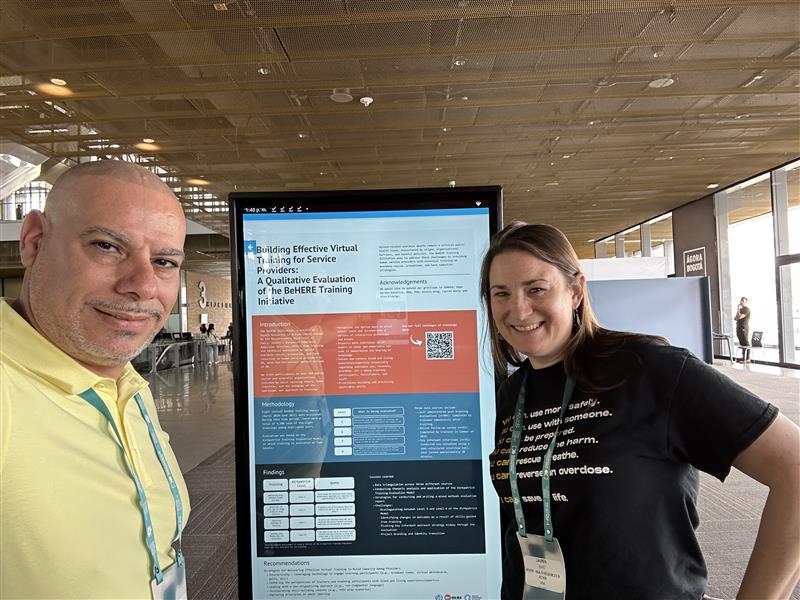
In 2023, thanks to the work of internal staff and external partners, BeHERE Training began to offer its first sessions entirely in Spanish on the topics of opioid overdose rescue, opioid overdose prevention, and de-escalation. Since then, the team has traveled to several conferences, presenting in English at the bilingual Harm Reduction 25 Conference in Bogotá, Columbia, in Spanish at the 2024 Puerto Rican Public Health Conference, and in Spanish at the 2025 Latino Behavioral Health Conference in Albuquerque, New Mexico. These opportunities have allowed staff to connect with professionals doing similar work across the world and share project learnings from training Spanish-speaking audiences in Massachusetts and conducting effective harm reduction training more broadly. The dedicated work of Spanish-speaking staff has significantly bolstered the availability of these resources in Spanish, but we recognize the need for even more work to get this important information out in more languages and more places, especially given the tremendous language diversity in Massachusetts where much of our work is based.
Two trainers on the team, Alex Fidalgo and Lauren Bard, use their Spanish language skills to further our work to expand access to training and other critical resources. We spoke with them to learn more about their work on BeHERE Training, the importance of offerings in Spanish, and how we should expand our thinking beyond just language access.
The following interview has been edited for length and clarity.
Edward Alexander: How did you come to be a trainer?
Alex Fidalgo: I’ve been a trainer for twelve years, with [BeHERE Training] for six years. First, I come to this because I’m a person in recovery. Second, when I first moved to Massachusetts, I heard about a recovery coaching class. I went and took the class and was like “this is it; this is what people need.” The class showed me there are multiple pathways of recovery, it provided options to folks. I really learned that the key component to help people is loving people and recovery coaching allows me to do that. To show some compassion, to try to understand people.
Lauren Bard: I’m a lifelong youth worker and social worker and a person in long-term recovery. Before HRiA I did a lot of things including managing youth and family support programs at a summer camp, directing youth development programs in a housing development in Boston’s South End, and leading drop-out prevention initiatives at a Boston Public High School. Throughout those roles, I delivered training on topics like bullying prevention, boundaries, and suicide prevention and became a consultant trainer for a gender-based violence prevention program at a university. Training allows me to share my experience and have an impact beyond the direct service roles I’ve held in the past.
Q: Why has it been important to have training offerings in Spanish as well as English?
AF: I remember having conversations with [BeHERE Training managers] and I said that we need people to understand about opioid overdose, but not everybody speaks English. In my case, I only speak two languages, English and Spanish, but best believe that I’d try to do trainings in French or whatever else if I could. The team took that seriously and we started doing bilingual trainings. I translated some stuff, and we started attending conferences in Spanish.
This country has over 65 million Latinos and the reality is that everyone doesn’t know English, but that shouldn’t be a barrier for people to have access to recovery information that can benefit them for the well-being of themselves or the well-being of their families.
Q: How does language justice differ from language access?
LB: I was a caseworker for the Department of Youth Services in Boston before going to the Peace Corps to do youth development work in Honduras—where I learned Spanish. I would sit in family meetings or treatment meetings, and we’d have translators and I’d think “this would be way better if I spoke Spanish and could talk to these families in their own language. I’m a white woman working in communities of color for most of my career, so there’s barriers to overcome in terms of connection and trust. [For me] having not just the language competency, but the cultural understanding having lived in Honduras, really set me up for connecting to young people and families from Central America. But speaking in Spanish improves quality of communication. It shows effort, care, concern, and genuine desire for everyone to have access to the same resources and opportunities.
AF: When you have access it’s just having information. Language justice is helping folks understand information, understand how to advocate for themselves. But it is also being sensitive to different cultures. Certain words mean different things to different communities. There is no universal Spanish for everybody.
Q: What has having more opportunities available in Spanish done for the growth and learning of participants?
LB: Serving folks in their native language is just better. Especially if folks are thinking in their native language having to make the effort to speak English is mentally exhausting.
We had the opportunity to go to a conference, Harm Reduction International (HR25), that was accessible to not just the English-speaking world, but accessible to the Spanish speaking world and indigenous communities. There were hundreds and hundreds and hundreds of people on this side of harm reduction. Coming together, sharing their successes, fighting with their whole lives.
AF: Being at conferences or at trainings delivered in Spanish has shown me that I’m doing the right thing. I talk to people and they say “Wow, I appreciate this, I didn’t even know this information was in Spanish.” You can see the epiphanies in people’s brains as they learn information. And I’ve made some good connections because of this work.
Reach out to the BeHERE Training team to request a training in Spanish.